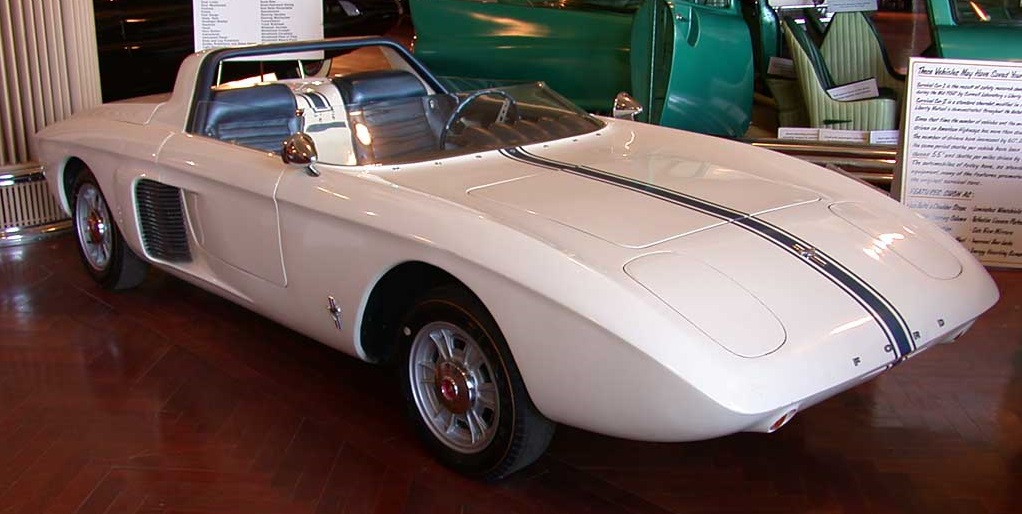
1962 Mustang Prototype
 |
1963 Mustang Prototype
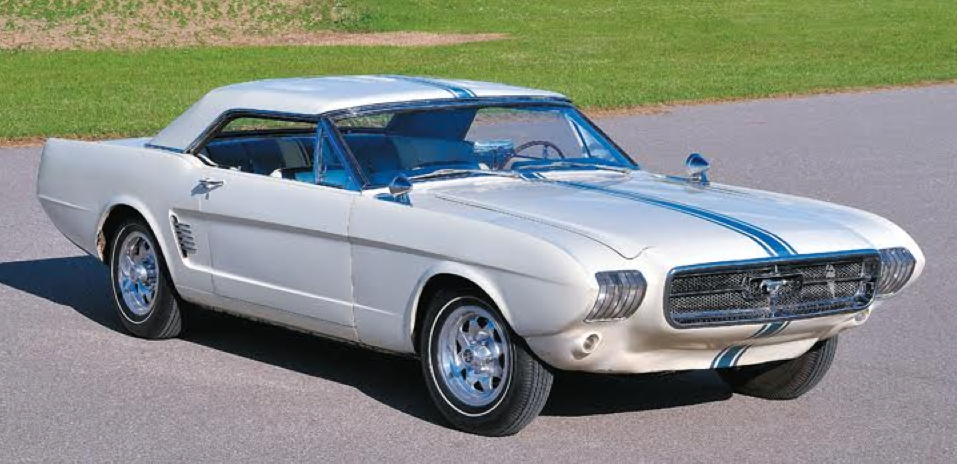 |
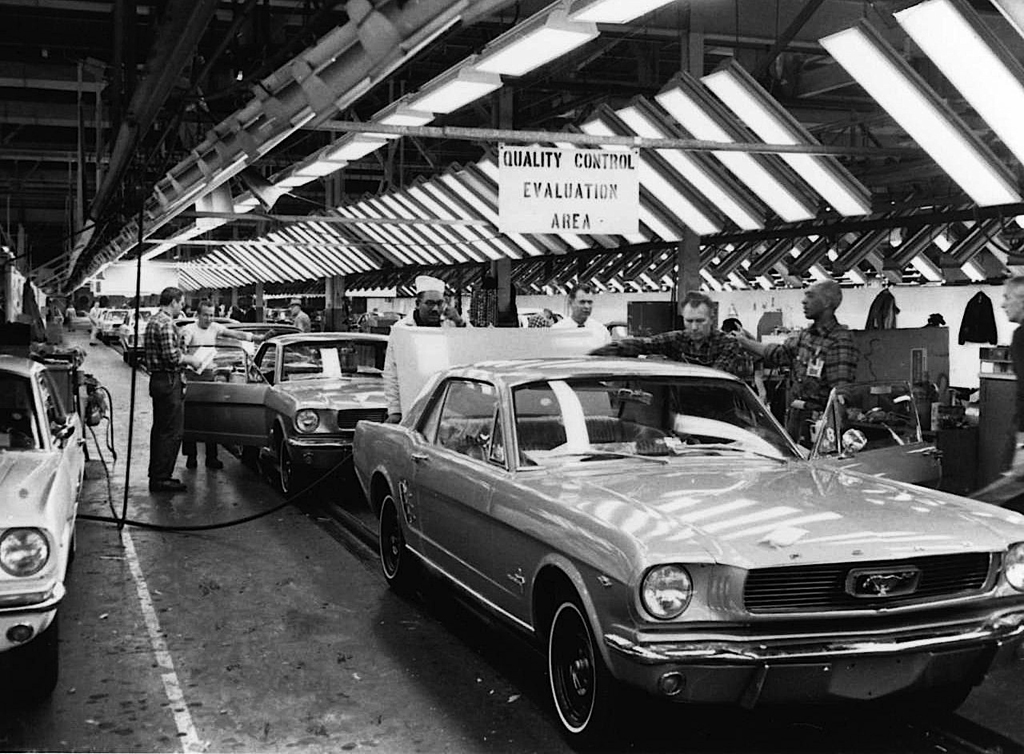
In 1961, Lee Iacocca, vice president and general manager of Ford Division, had a vision. His vision was a car that would seat four people, have bucket seats, a floor mounted shifter, be no more than 180 inches long, weigh less than 2500 pounds, and sell for less than $2500.00. Out of this vision, the Ford Mustang was born. After many months of meetings, discussions and market surveys, funding was finally approved for the Mustang in September of 1962. On March 9, 1964 the first Mustang rolled off of the assembly line.
Only 18 months had elapsed since the Mustang had been approved for production. In order to keep production costs down, many of the Mustang's components were borrowed from the Falcon, including most of the drivetrain. With a multitude of different interior, exterior, and drivetrain options, the Mustang would be able to be ordered as plain, or as fancy, as economical, or as fast, as the buyer wanted. In general, the Mustang was designed for everyone and was advertised as "the car to be designed by you".
The Ford Mustang was heavily advertised during the latter part of it's development. On April 16, 1964, the day before it's release, Ford ran simultaneous commercials at 9:30pm on all three major television networks, ABC, NBC, and CBS. The following day, April 17, 1964, people "attacked" the Ford showrooms. Everyone was in a frenzy to be one of the first to own the Mustang. Ford sold over 22,000 Mustangs the first day. By the end of the year, Ford had sold 263,434. By the end of the Mustang's first anniversary, April 17, 1965, Ford had sold 418,812 Mustangs. The Mustang had made a name for itself, and it was here to stay!!!
The First Production Mustang off the Assembly Line
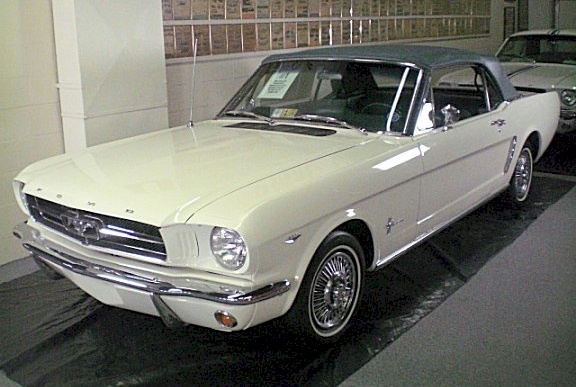
The 1964½, as it was later called, was available in only two models: the coupe and convertible. Both models featured a lengthened hood and shortened rear deck, chrome wrap-around bumpers, chrome grille with a running horse, and full wheel covers. Both models were available with a 170 cid, 101 horsepower, 6 cylinder engine, a 260-2V, 164 horsepower V-8, a 289-4V, 210 horsepower V-8 and, starting in June, a fire breathing, 4 barrel, solid lifter, 271 horsepower, 289 cid V-8 engine. The buyer had a choice of a 3 speed, 4 speed or automatic transmission, and a variety of rear end gear ratios. The interior featured "wall-to-wall" carpeting, front bucket seats or an optional front bench seat, rear bench seat, a sports car style steering wheel, floor mounted shifter, and full headliner. There were a total of 121,538 Ford Mustangs produced during the 1964½ model run.
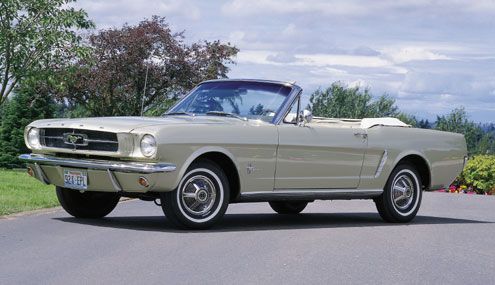
1965 Mustang Convertible
 |
1965 Mustang 2+2 Fastback
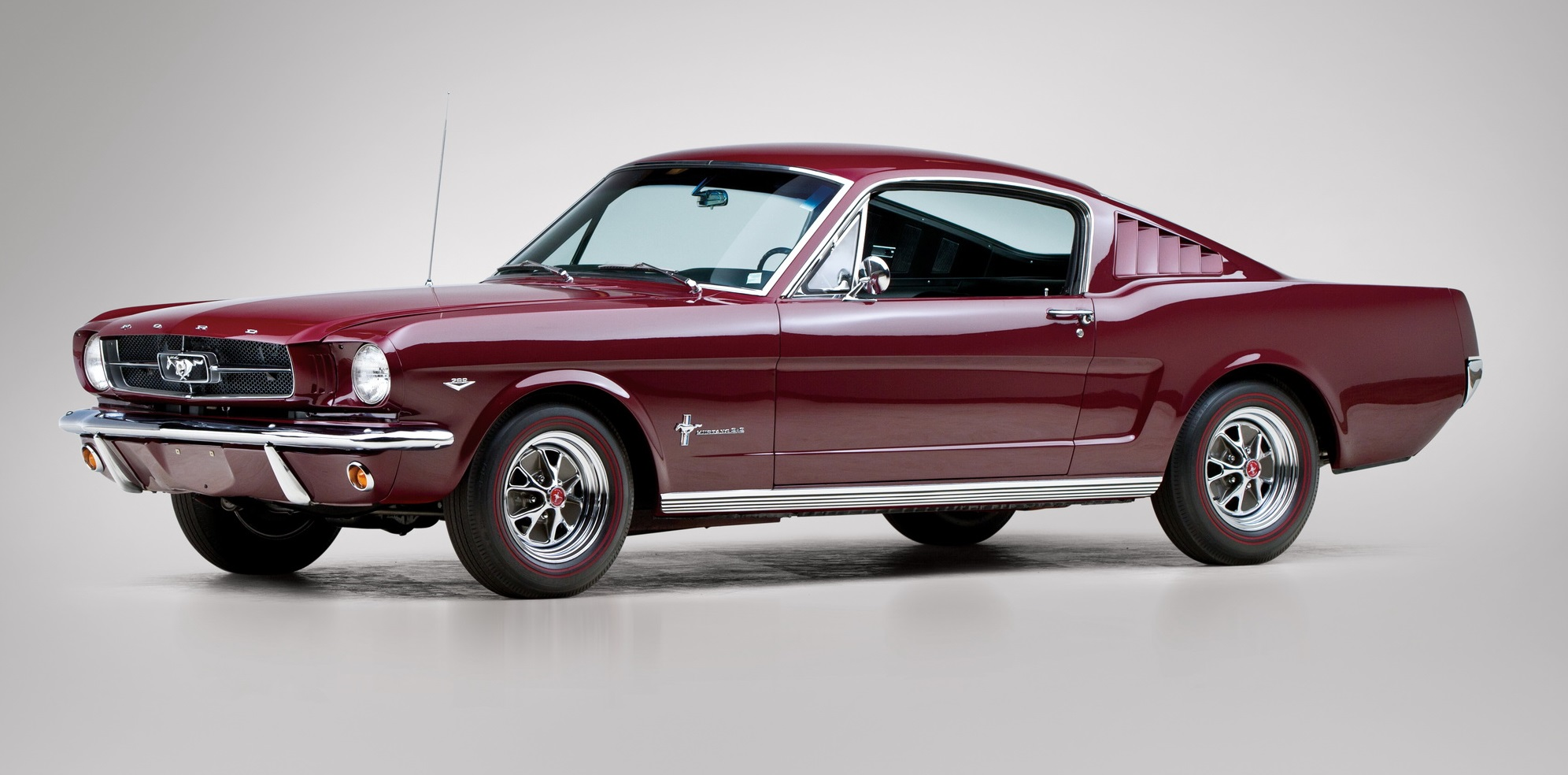 |
1965 brought few changes for the Mustang. The biggest change was the availability of a new fastback model, which was to become the basis for Carroll Shelby's GT350. The 120 horsepower, 200 cid 6 cylinder engine replaced the 170 cid 6 cylinder, the 289-2V, 200 horsepower V-8 replaced the 260-2V, the 289-4V was upgraded to 225 horsepower, and the 289-4V hi-po remained unchanged. Other changes for the 1965 Mustang included: an alternator instead of a generator, relocation of the oil filler, integral power steering pump and resevoir (most 1964½'s had a remote mounted resevoir), a wire retaining ring was added to the gas cap, the horns were smaller and relocated, and the interior carpet was continued up the sides of the rocker panel and under the sill plate.
A new interior option was added, the interior decor group (known as the pony interior), which featured special seat covers with running horses across the seat back, special interior door panes with integral arm rests and pistol grip door handles, five gauge instrument panel, woodgrain steering wheel, and woodgrain appliques on the instrument cluster, glovebox, and optionally on the center console. Another Mustang option introduced in April of 1965 was the GT equipment group. Available only with one of the two four barrel engines, the GT group included five-dial instrumentation, disc brakes, larger sway bars, quicker steering ratio, dual exhaust which exited through the rear valance panel, grill mounted foglights, and special lower body side stripes. A total of 559,451 Mustangs were produced for the 1965 model year.
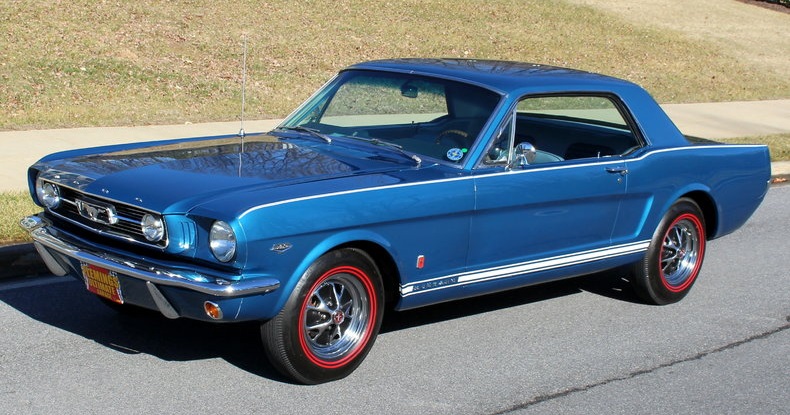
1966 Mustang GT Coupe
 |
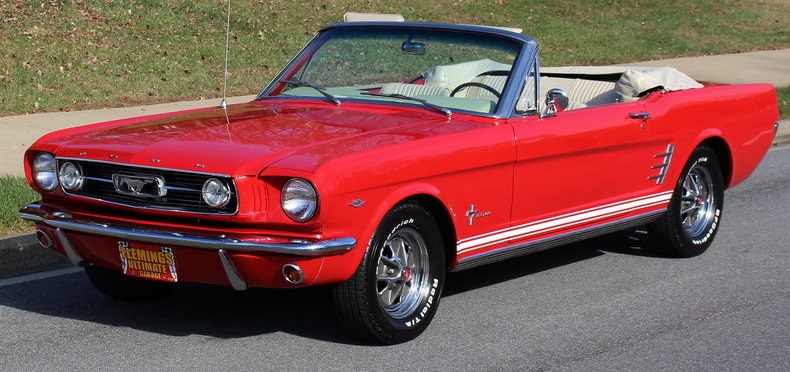
1966 Mustang GT Convertible
 |
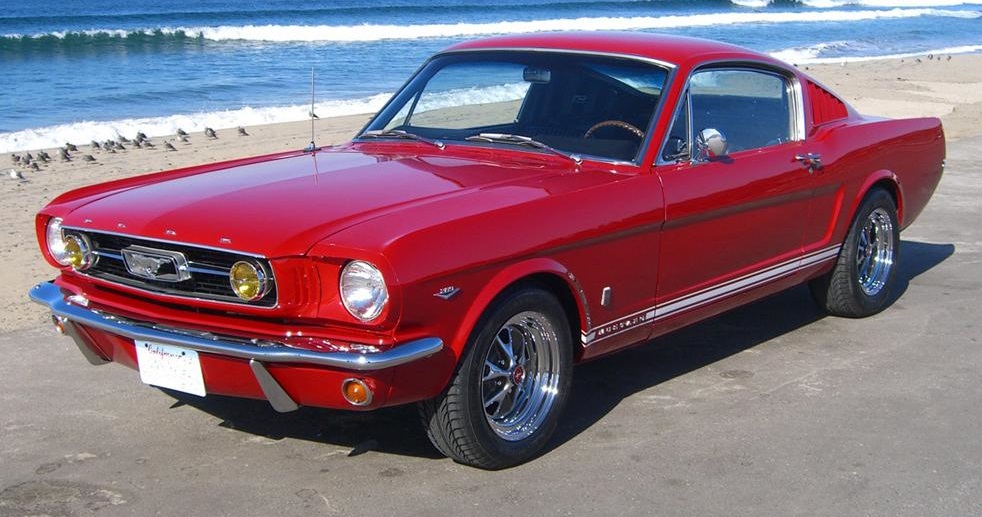
1966 Mustang GT Fastback
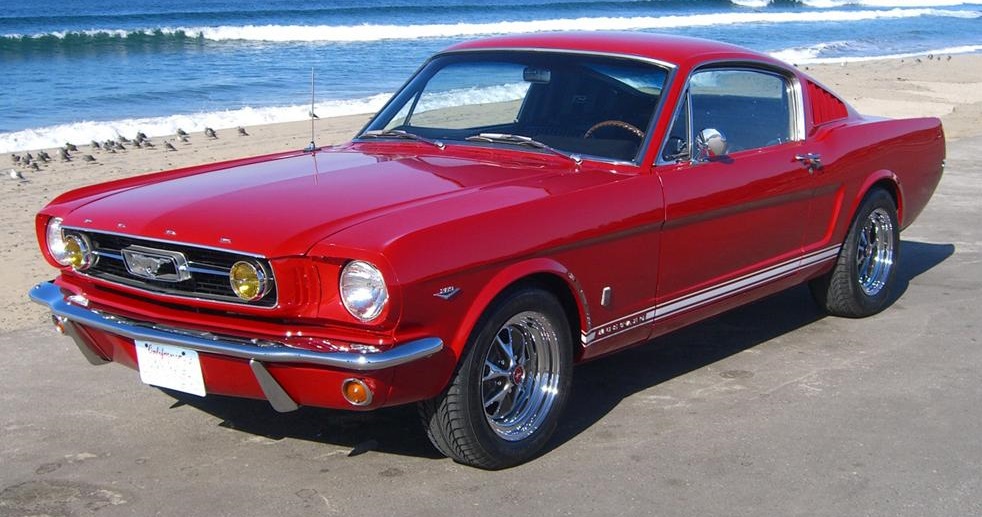 |
1966 brought even fewer changes for the Mustang than did its predecessor. Most of the changes for 1966 were in the form of cosmetic refinements. A new grille which featured chrome edged, horizontal inserts, replaced the honeycomb grille of '65. The chrome bars that extended horizontally and vertically from the running horse were deleted on the 1966 Mustang's grille. A new three fingered rear quarter panel ornament was used. The lower rocker panel moulding became standard equipment, as did backup lights, and a chrome hood lip moulding. The fuel filler cap no longer included the plastic Mustang emblem insert found on the earlier models. On the inside, the Mustang was treated to standard five gauge instrumentation, and "woven" vinyl seat inserts. The choices of available interior colors and styles increased to thirty four varieties, giving the buyer even more ways to personalize "their" Mustang. Production increased to 607,568 units for 1966.
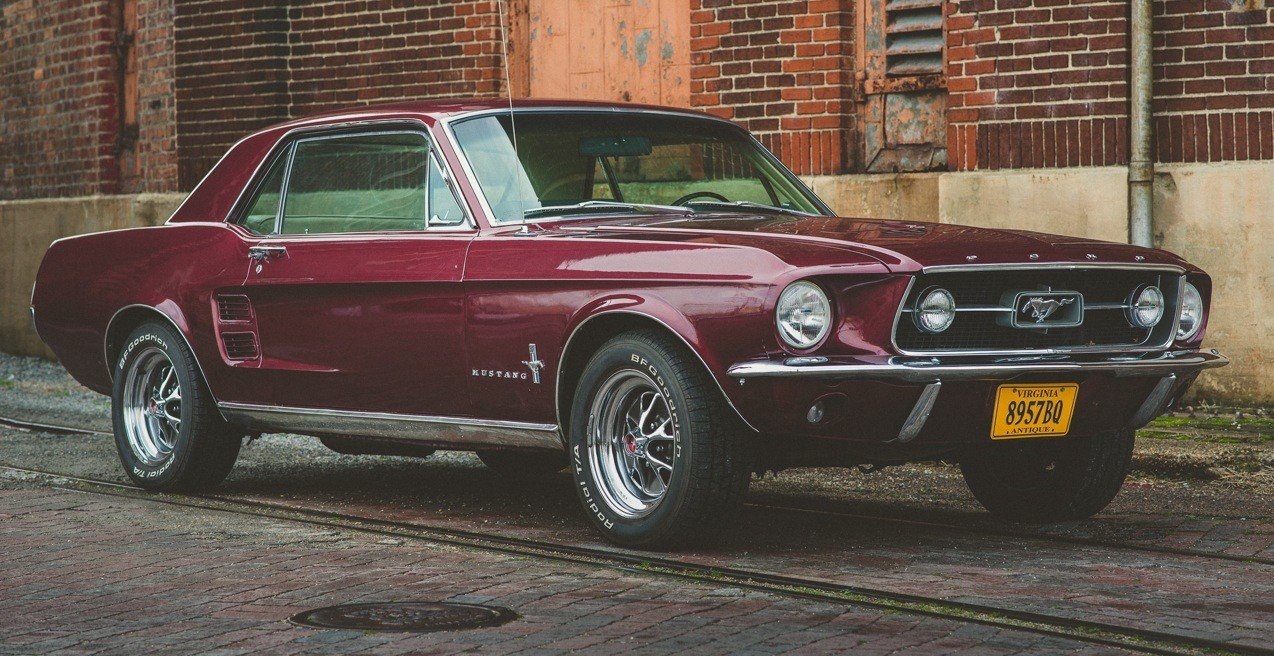
1967 Mustang GT Coupe
 |
1967 Mustang Convertible
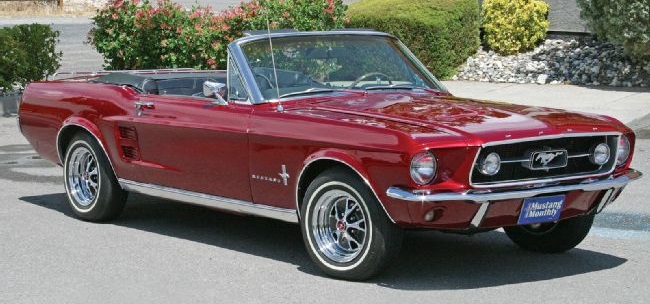 |
1967 brought the first major restyling to the Ford Mustang. The Mustang was starting to grow up. The length and heigth were increased, 2.7" and .5" respectively. The wider body allowed for the installation of a tire smoking, 320 horsepower, 390 cid engine, the first big block engine in the Mustang. Among new options for the 1967 Mustang were the tilt-away steering wheel, an overhead console, power disc brakes, and an all new transmission, the FMX, which allowed fully automatic or manual shifting. The Mustang fastback's roof line was extended to the rear of the trunk. Interior trim options were decreased from 34 in 1966 to just 20 in 1967. Production for 1967 slipped to just over 472,000 units.
1968 Mustang
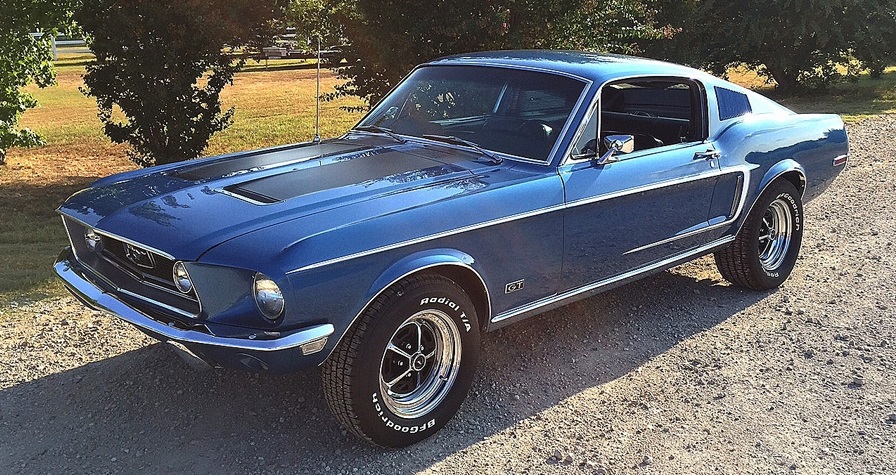
GT Fastback
 |
1968 Mustang
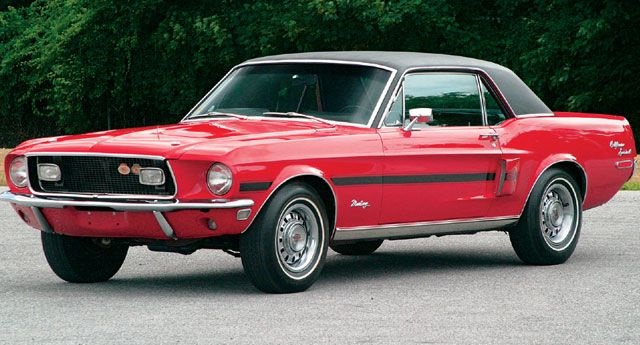
California Special
 |
1968 Mustang
High Country Special
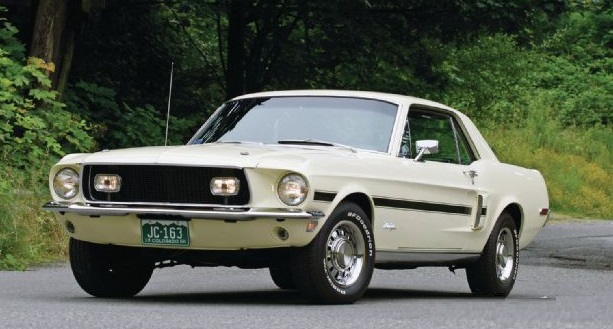 |
The 1968 Mustang was little changed from it 1967 counterpart. Most of the changes were in subtle refinements to the interior and exterior. New options for the 1968 Mustang included an AM/FM stereo radio, rear window defogger (coupe and fastback only), re-designed front power disc brakes, and the all new 302 cid engine. The 302-4V, 230 horsepower engine replaced the 289 Challenger Special of previous years.
By December of 1967, the 289 engine was replaced entirely by the 302 version. Other changes included the deletion of the horizontal grille bars, the deletion of the F-O-R-D letters at the front of the hood, simplification of the quarter panel ornament, and many safety features were added. Due to increasing governmental regulations, the 1968 Mustang now included front and rear side marker lights, folding, flush mounted interior door pulls, and an energy absorbing steering column. There were several "region specific" models offered from various dealers. Two of the most noteable were the Mustang California Special, and the Mustang High Country Special. Total production for 1968 was 317,404 units.
1969 Mustang SportsRoof
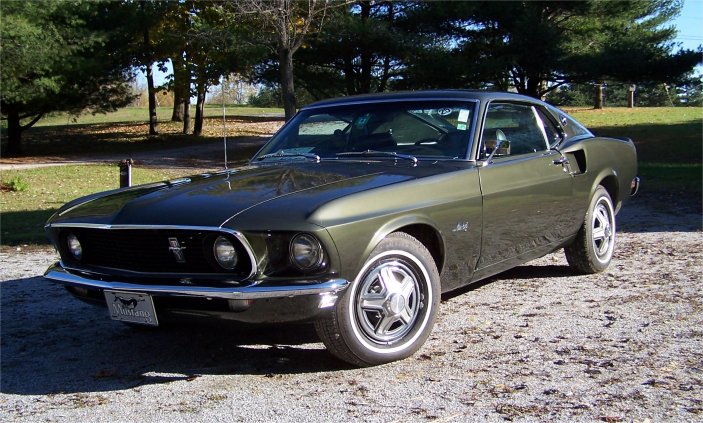 |
1969 brought another major restyling to the Mustang. The Fastback 2+2 was gone - replaced by the new SportsRoof model. The new Mustangs were almost 4 inches longer than their 67/68 predecessors, yet they retained the 108" wheelbase of the original 1964½. The base Mustang engine continued to be the 200 cubic inch six cylinder. New for the economy minded Mustang owner was an optional 250 cubic inch six. The base V-8 continued to be the 302-2V. The 351-2V and 4V entered the lineup for 1969. The 302-4V and the 390-2V were dropped, but the 390-4V remained.
There were two special engines offered for 69, the Boss 302 and the Boss 429. Both engines were only available in two limited production units, so called, the Mustang Boss 302 and the Mustang Boss 429. New features for 1969 included quad headlights, front parking lights were now located behind the front valance panel, new quarter panel ornaments, side scoops and integral rear spoiler on the SportsRoof models, front seat back locks, and for the first time, the VIN number, in addition to being located on the driver's door, was also attached to the instrument panel, and visible through the windshield.
There were several new Mustang models offered during 1969. A little know model was the Mustang 'E'. It was basically a standard economy minded Mustang SportsRoof model with a six cylinder engine, a higher (lower numerically) ratio rear end with a large torque converter, and an automatic transmission. Air conditioning was not available on the 'E' model. A "Mustang E" insignia replaced the standard quarter panel ornament. Another new model was the Mustang Grande, which included the Interior Decor Group, an electric clock, special houndstooth check upholstery, and extra sound deadner.
Another new model was the Mustang Mach 1 which was only available with one of the five larger V-8 engines. It featured special interior trim, special carpet, and high back bucket seats. On the exterior, the Mach 1 featured a low-gloss black hood, non-functional hood scoop (except models equipped with the 428 Cobra Jet engine which had a "new for 69" shaker scoop), hood pins, dual racing mirrors,special side stripe, pop-open gas cap, and dual exhaust ending in chrome, quad outlets. The Mustang Mach 1 also included the "Handling Suspension" and an additional 55 pounds of sound deadner and insulation materials.
Another new model for '69 was the Mustang Boss 302. Built mainly to qualify the Mustang for the SCCA (Sports Car Club of America) Trans-Am series. The Boss 302 included a special 290 horsepower, 302 engine, 4 speed transmission, 16:1 ratio steering box, and a 3.50:1, staggered shock rear end. The exterior featured a low-gloss, black hood and deck lid, Boss 302 "C" stripes, front spoiler, flared fenders and Magnum 500 wheels with F60x15 tires. All of the optional Mustang interiors were available on the Boss 302, however, most of them were equipped with the black, standard Mustang interior.
The biggest and baddest of the Boss's, the Mustang Boss 429, was also introduced in 1969. Primarily built to satisfy NASCAR requirements, the Boss 429 Mustang featured a Semi-Hemi 429 powerplant. To compensate for the massive engine, the front shock towers were moved out one inch, and the front A-Arms were lowered one inch. The Boss 429 featured a huge hood scoop (the largest ever offered on the Mustang), front spoiler, flared fenders, dual racing mirrors, and F60x15 tires, mounted on chrome, Magnum 500 wheels. The interior featured the Mustang interior decor group, comfortweave bucket seats, and console. The Boss 429 also featured a competition suspension, rear stabalizer bar, power front disc brakes, power steering, engine oil cooler, trunk mounted battery, and a 3.91:1, traction lock rear end.
There were a total of 299,824 Mustang's built in 1969.
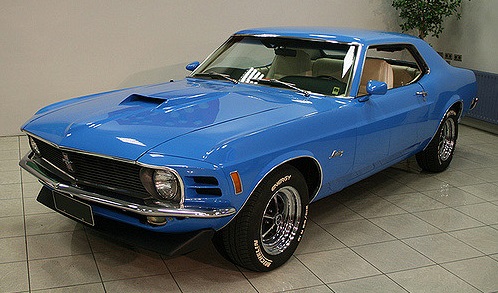
1970 Mustang Coupe
 |
1970 Mustang Grande
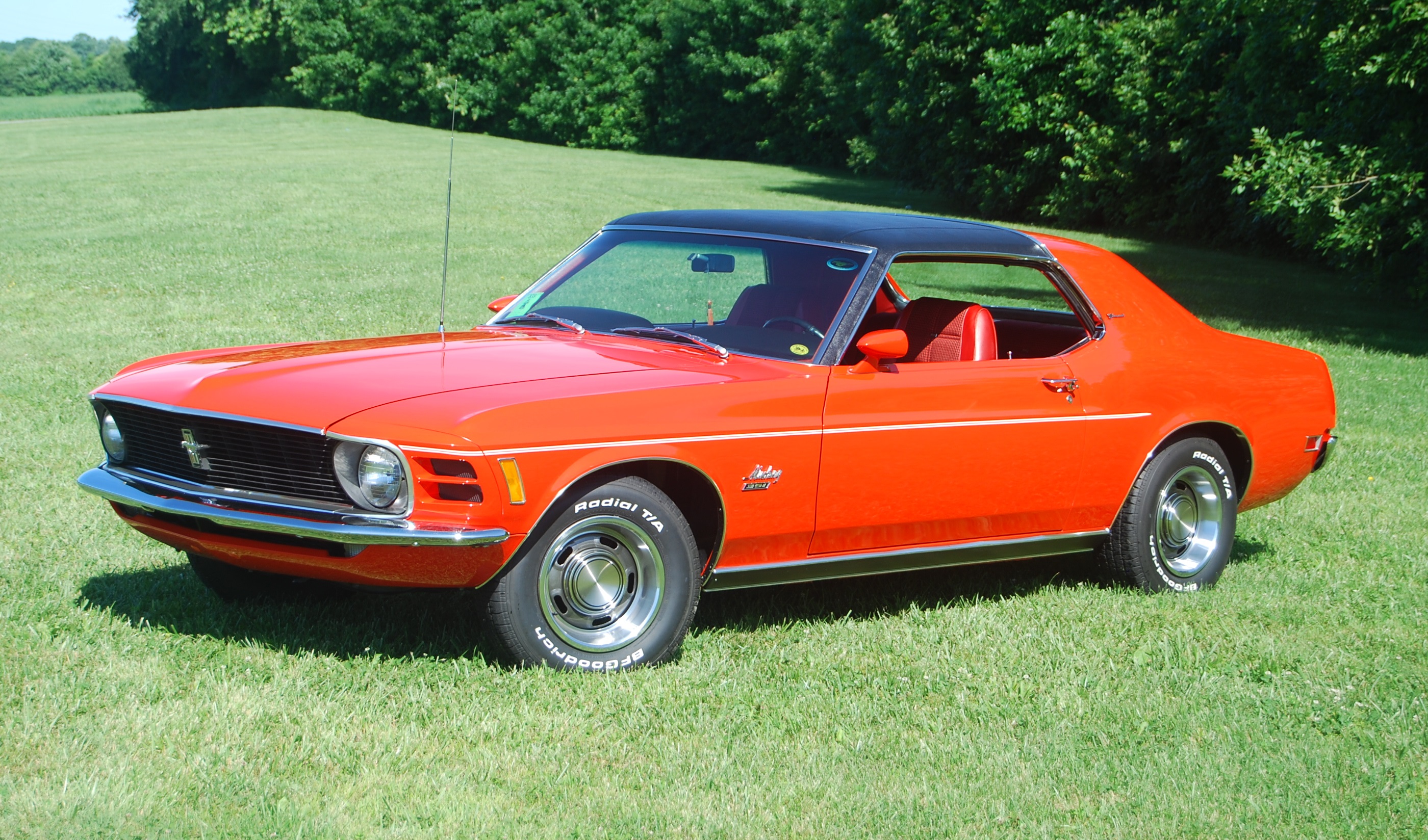 |
1970 saw no major changes to the Mustang lineup. Most of the changes were in the way of subtle refinements. The headlights became dual units again instead of the quad units used in 1969, front side marker lamps were moved up onto the fenders, the quarter panel "scoops" were deleted, and the rear taillights were now recessed into their housings. On the inside, high back buckets became standard equipment with the seat back release moved to the lower part of the seat, a new "oval" steering wheel (supposedly to ease entry and exit), and the ignition switch was moved to the steering column which locked the steering wheel when turned to the off position. The engine lineup changed slightly for the 1970 Mustangs. The 390 was dropped and the 351-2V Cleveland and 351-4V Cleveland replaced the 351 Windsor models of previous years. The Mach 1, Boss 302, and Boss 429 were all available in 1970. Total Production for 1970 was 190,727 units.
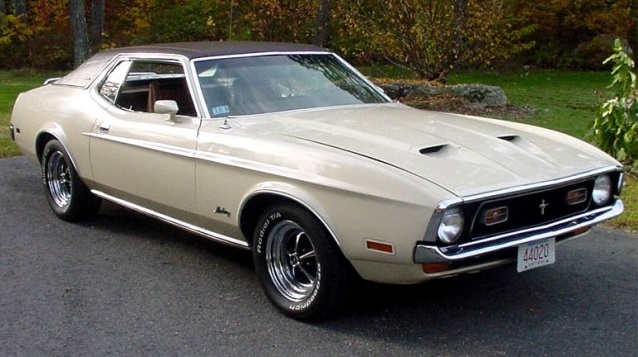
1971 Mustang Grande
 |
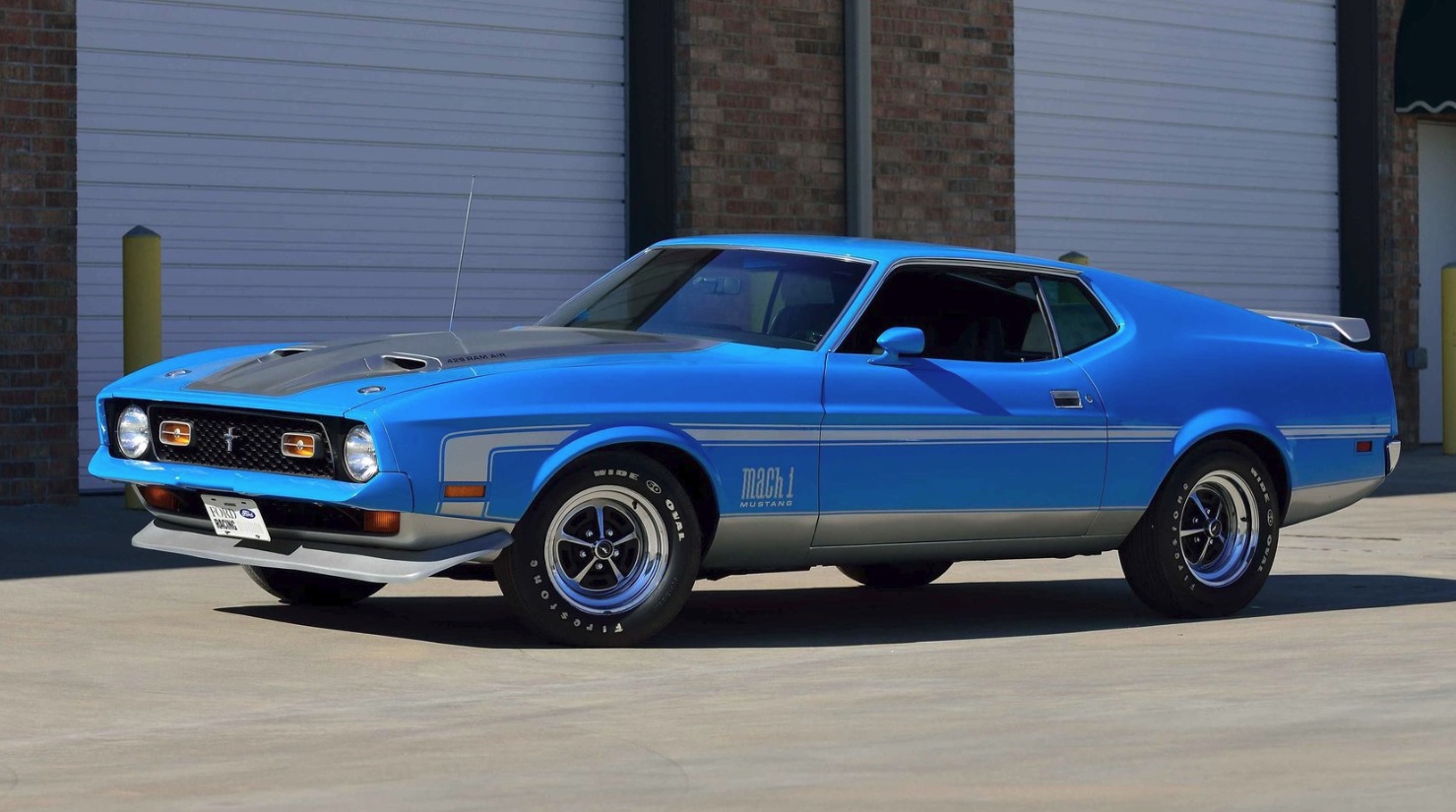
1971 Mustang Mach 1
 |
1971 saw another major restyling change for the Ford Mustang. It was also to be the last restyling for the first generation Mustang. Introduced late in August of 1970, the new Mustang was more than two inches longer and almost two and a half inches wider than it's 1970 predecessor. For the first time since the Mustang's inception, the wheelbase was extended one inch to 109". The 200 cid 6 cylinder was dropped along with the 428, the Boss 302, and the Boss 429. New engines for '71 were the Boss 351, the 429, and the Ram Air 429. The Mustang Boss 351 produced 330 horsepower, while both 429 engines produced 370 horsepower.
On the exterior, the famous Mustang corral returned. A new wide chrome strip on the edge of the front fenders and hood was borrowed from the 1969 Shelby's. The long hood now turned up at the windshield to cover the hidden wipers. Large, bold, triple lens tail lights appeared on the rear of the new Mustang. Flush mounted door handles replaced the earlier surface mounted units.
The interior featured standard high-back buckets, a mini console, and an all new instrumentation layout. Power windows were offered for the first time. The Mustang Mach 1 continued to be offered for '71. It was available with any of the V8 engines. A special honeycomb grille and color keyed front bumper were unique to the Mach 1 model. The chrome hood and fender mouldings were replaced with color keyed trim. "Mach 1" decals were placed on the fenders and deck lid and a special black or argent lower body side paint was used.
New for 1971 was the Mustang Boss 351 which replaced the Boss 302 and Boss 429. The Boss 351 featured a special 330 horsepower 351-4V Cleveland engine. The Boss 351 featured a blacked out NASA scooped hood with twist type locks and special body side stripes. The Boss 351 included a competition suspension with staggered rear shocks, a four speed transmission with a Hurst shifter, power front disc brakes, dual exhaust, and 3.91:1 traction lock rear end.
There were a total of 149,678 Mustangs built in 1971.
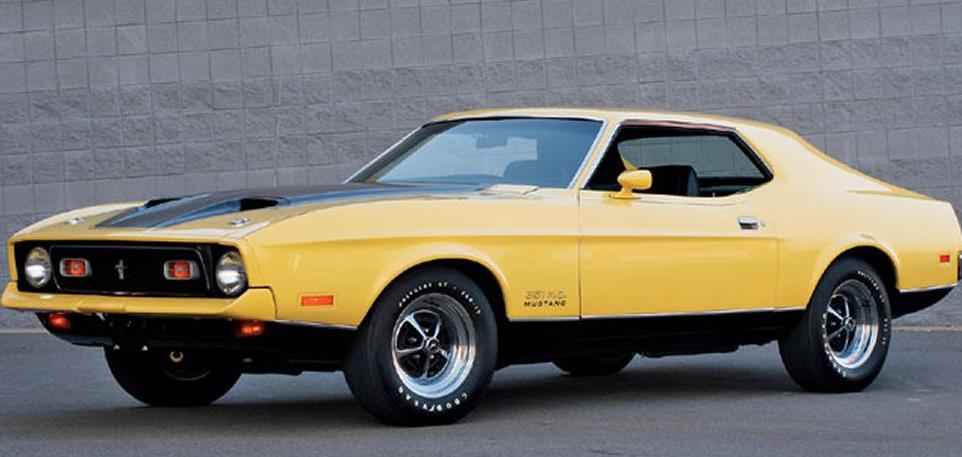
1972 Mustang Coupe
 |
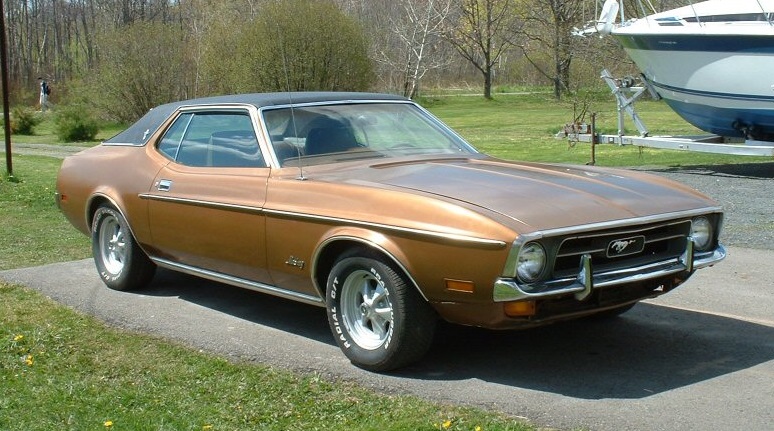
1972 Mustang Grande
 |
1972 Mustang Mach 1
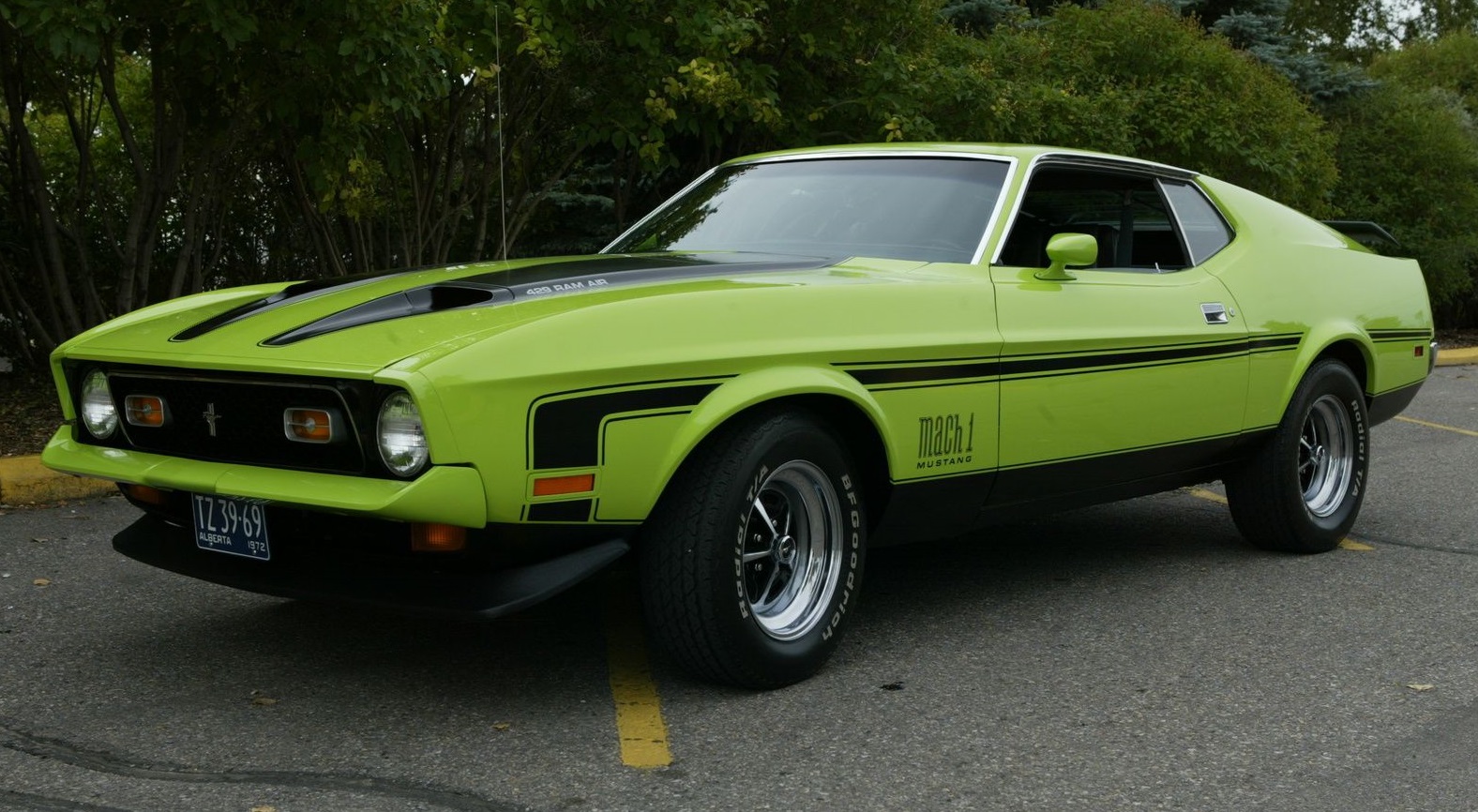 |
Since the Mustang had undergone a major restyling in 1971, the 1972 Mustang models saw no big styling changes, only minor cosmetic ones. Probably due to increasing governmental fuel economy regulations, all of the Boss cars were dropped from the 1972 lineup. The Boss 351 and both versions of the 429 engine were dropped. During the early part of '72, a special 351HO model was offered. It featured a low compression version of the Boss 351 engine, with a special high-lift cam, mechanical lifters, forged aluminum pistons and a special 4-barrel manifold. The only "performance" model that remained for the entire '72 model year was the Mustang Mach 1. The Mach 1, like all other '72 models, were virtually unchanged.
Production for 1972 topped out at 125,093.
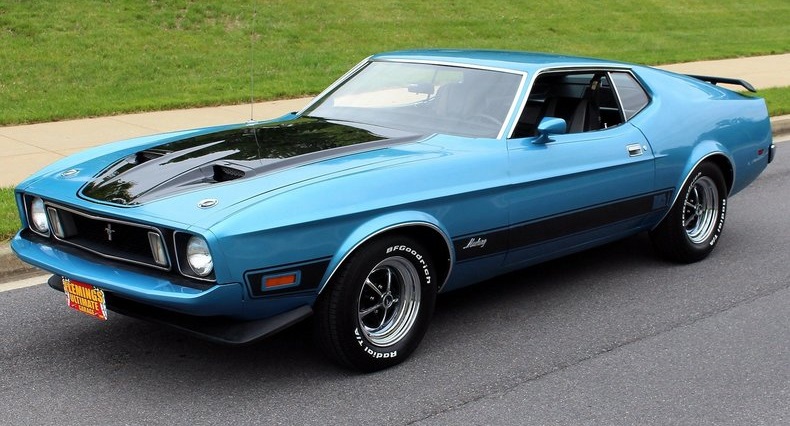
1973 Mustang Mach 1
 |
1973 Mustang Convertible
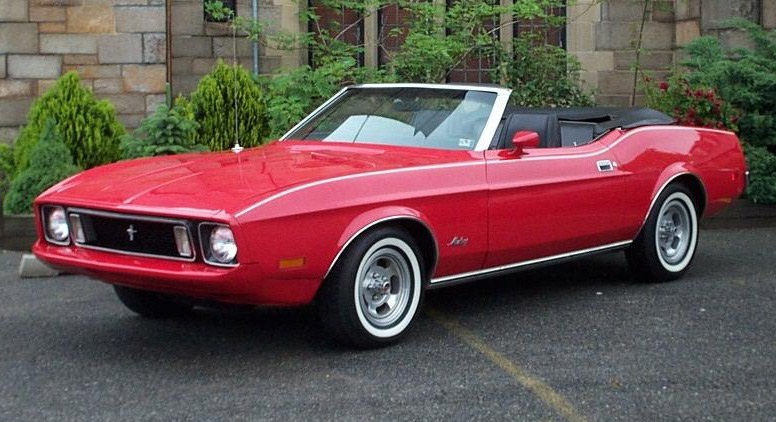 |
1973 brought the last year of the "big" Mustang. It was to be replaced by a smaller, lighter breed, therefore, most of the changes for '73 were merely cosmetic. A large, square, chrome headlamp bezel appeared, as did chrome trim around the tail lights. A color keyed Urethane front bumper replaced the chrome units of the previous years. The front parking lights were now placed vertically in the front grille. A new, grained, black applique with bright trim was placed on the rear body panel between the tail lights. This was replaced with a honeycomb style on the Mustang Mach 1 and Mustang Grande models. The 1973 Mustang convertible was to become the last Mustang convertible for many years. There were a total of 134,867 Mustangs produced in 1973.
The Mustang is, of course, one of Ford’s classic and most well-known vehicles. Chances are if you’re here, you’re an enthusiast for that type of thing; if what you saw here really piqued your interest, why not do a little browsing and see if you can find one to make your own? There are classic cars for sale all over the web, and there might be one with your name on it.
Copyright © 2019 Class 1 Classic Cars, LLC. All Rights Reserved
|