|
In late 1964, Ford Motor Company teamed with Carroll Shelby to build
an all new sports car based on the new Ford Mustang fastback. The goal was
to create competition for Chevrolet's Corvette. On January 27, 1965,
the competition arrived! At first glance, the Shelby GT350 looked like a regular
Mustang fastback, but on closer inspection, looks were where the similarities
stopped.
The 1965 Shelby GT350's were white fastbacks shipped from Ford's
San Jose plant without hoods and rear seats but with disc brakes,
a four speed transmission, and the 271hp 289 engine. The cars were
then prepared by Shelby's crew. Some of the changes included: the engine
was beefed up to 306 horsepower, the front suspension was lowered
1", the rear seat was replaced with a fiberglass panel that held the
spare tire, the battery was relocated to the trunk area, and a fiberglass
hood with a functional scoop was installed. Other changes included
the installation of a 1" front sway bar, Koni adjustable shocks, rear
traction bars which were located above the rear axle, a 9" rear end was added,
a dash mounted gauge pod which housed a tachometer and oil pressure
gauge, and 3" competition seat belts. The Mustang Shelby was basically a full
bred race car that could be bought straight out of the Ford dealer's
showroom. There were a total of 562 Shelby GT350's built in 1965,
550 street models and 12 race models.
1966 Shelby GT350
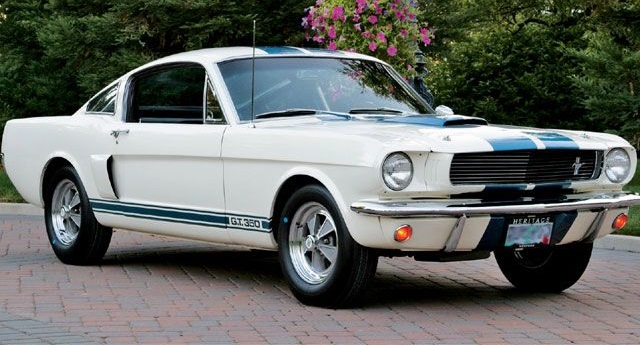
The 1966 Shelby underwent some minor changes. Most of these changes
were because Ford decided that they wanted to make a profit on the
cars. This made some of the modifications that were originally considered
necessary - unnecessary. Approximately 200 of the 1965 Shelbys were
held over and retitled as 1966's. These early models retained the
1965 changes. Some of the things no longer considered necessary
were relocating the battery to the trunk and lowering the front
A-arms. The rear traction bars which were originally installed over
the axle were changed to simpler units that went under the axle.
14" wheels became standard, rather than the 15" units furnished previously.
Since the 1966 Mustang's instrument cluster now included an oil
pressure gauge, the instrument pod was discontinued and a seperate
tachometer was mounted on top of dash pad.
One of the biggest visual
differences to the 1966 Shelby, was the replacement of the rear air extractor
with a clear plexiglass window. During the 1966 model year, Ford
received a contract from Hertz Rent-a-Car for 1,000 specially prepared
units. Although they didn't quite make the 1,000 mark, they came
close. 936 Hertz Shelby GT350's were produced in 1966. All Hertz
units were supplied with gold side stripes that read, G.T.350H.
Most of the units also had gold LeMans stripes, but not all. The
Hertz models were shipped with chrome Magnum 500 wheels. The very
early Hertz models were shipped with a 4 speed transmission, all
of the rest had automatics. There were a total of 2,378 1966 Shelby GT350's
built. Of these, 1,433 were street models, 936 were Hertz models,
3 were race models, and 4 were specially prepared convertibles.
The convertibles were not offered for sale to the public, they were
for Carroll Shelbys friends, his secretary, and himself.
1967 Shelby GT500
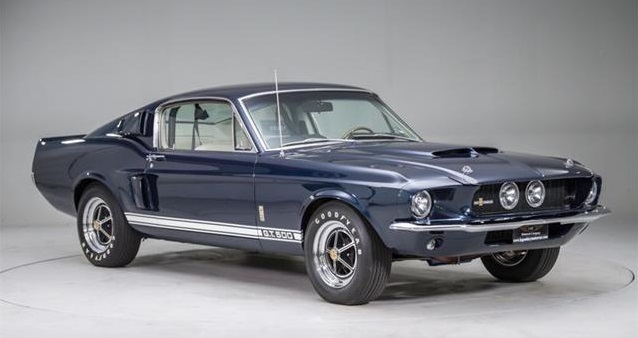
The 1967 Shelby was more of a radical departure from the standard
Mustang. Through the extensive use of fiberglass, the Mustang
was transformed into an agressive looking machine. The front end
of the 1967 Shelby was extended about three inches with a fiberglass
extension, hood, and fenders. The hood featured a massive, dual
scoop. The rear of the car featured a fiberglass trunk lid with
built in spoiler that blended into the quarter panel extensions.
The early 1967 Shelbys had driving lights placed together in
the center of the grill and red side marker lamps mounted in the
upper rear quarter panel scoops.
The side marker lights were discontinued
due to the DOT regulations in some states. There are contradicting
reports as to why the driving lights were moved to the outside
of the grille. Some reports say that it was done because of the
DOT regulations in some states, others say it was because it hampered
the engine cooling. The big news for 1967 was Shelbys new model
- the GT500. With Ford's addition of the 390 engine in the Mustang,
it opened the path for the big block Shelby. Carroll Shelby, in
his usual fashion, decided to go one up on Ford by installing
a 428cid engine. The 428 boasted 355 horsepower at 5400 rpm and
420 foot pounds of torque at 3200 rpm.
There were a total of 3,225 Shelbys built in 1967 - 1,175 GT350's
and 2,050 GT500's.
|
1968 Shelby GT500
|
1968 Shelby GT500 Convertible
|
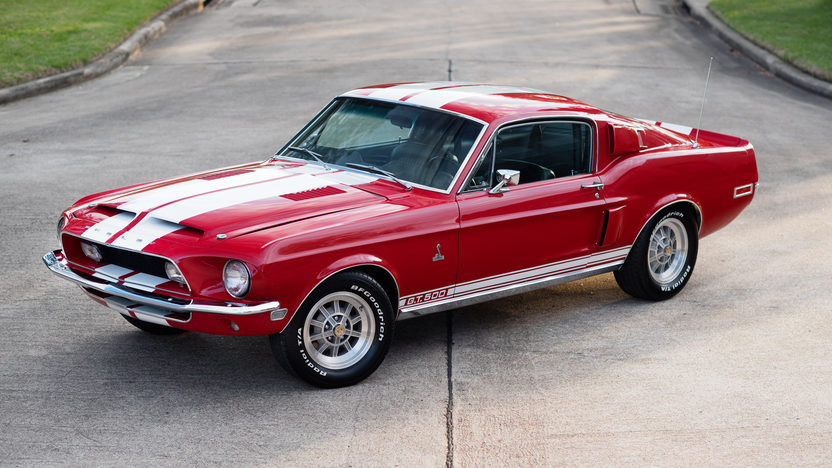
The 1968 Shelby, like the 1968 Mustang, was little changed from
it's 1967 counterpart. 1968 was the first year that the name Cobra
was actually attached to the breed. The cars were now known as
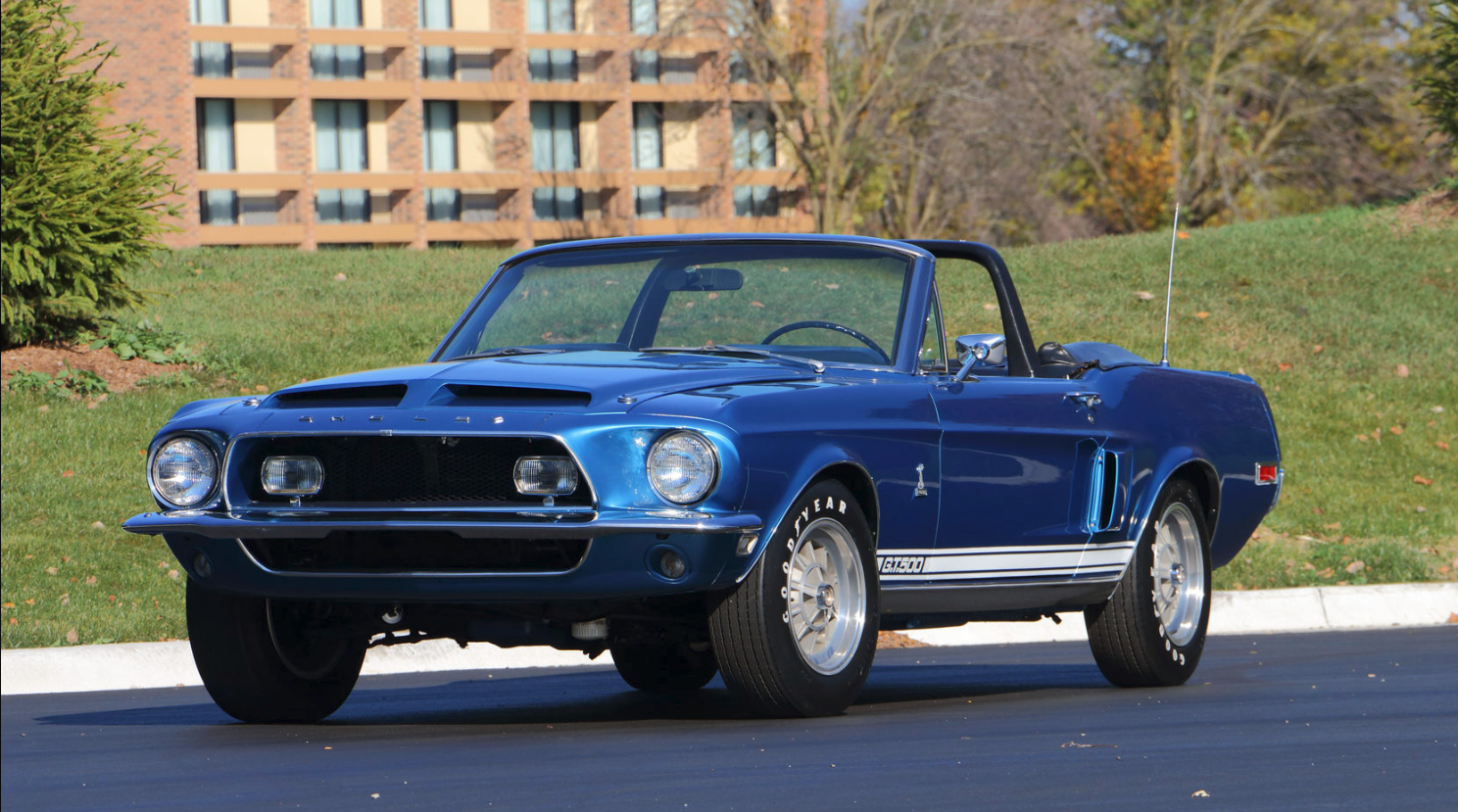
the Shelby Cobra GT350 and the Shelby Cobra GT500. The biggest
news for the 1968 Shelbys was the addition of the convertible.
The Shelbys again were offered with the 302-4V for the GT350's
and the 428-4V for the GT500's. At some point, the 428 Cobra Jet engine was offered
in the GT500's. With the addition of the 428 Cobra Jet, a new
model was born - the GT500KR (for King of the Road).
The hood
of the '68 Shelbys boasted two large scoops that almost engulfed
the entire hood. The tail lights on the 1968's were 1965 Thunderbird
units complete with the sequential indicators. The interiors featured
the Mustang deluxe seatcovers and walnut-grained appliques, full
instrumentation including an 8000 rpm tachometer and 140mph speedometer,
and a padded center console with the "coiled cobra" embossed on
the storage cover. There were a total of 4,450 Shelby Cobra's
built in 1968, 1,253 were GT350 Fastbacks, 404 were GT350 Convertibles,
1,140 were GT500 Fastbacks, 402 were GT500 Convertibles, 933 were
GT500KR Fastbacks, and 318 were GT500KR Convertibles.
|
1969 Shelby Cobra GT350
|
1969 Shelby Cobra GT500
|
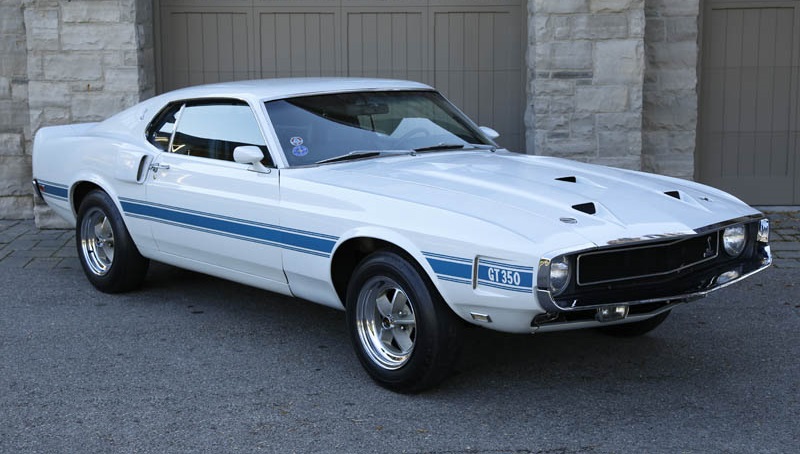
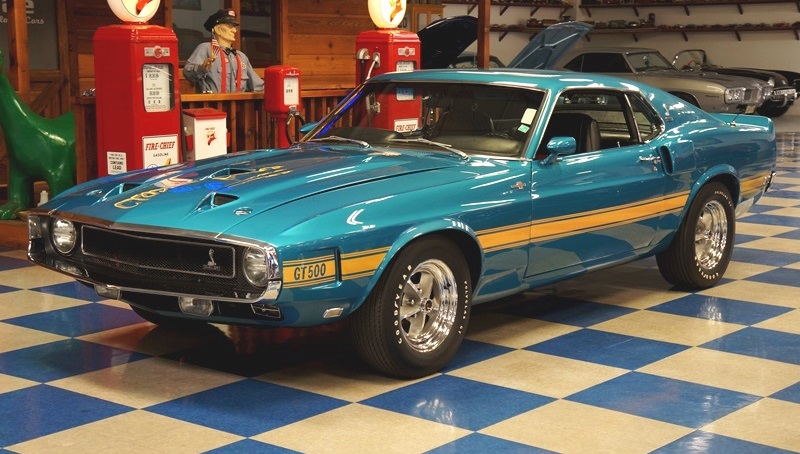
1969 was to be the last year that the Shelby was built. A few
of the 1969 Shelby's were held over and retitled as 1970 units, but in
all actuality, 1969 was the last year of this fine breed. The
engine lineup was changed to include an optional (the 302 was
still standard) 351-4V Ram Air engine for the GT350 and only the
Ram Air 428 for the GT500's. 1969 was the year of the "scoops".
The Shelbys had five scoops on the NASA style hood, one at the
front of each fender, and one on each quarter panel. The Lucas
driving lights were now mounted below the front bumper, rather
than in the grille.
The dual exhaust system now exits through
a massive aluminum outlet mounted in the center of the rear valance
panel. The license plate was moved up to the center of the rear
body panel and hinged to allow access to the fuel filler cap.
The interior continued to be the deluxe Mustang trim as in previous
years. There were a total of 3,150 1969 and 1970 Shelbys produced,
1,085 were GT350 Fastbacks, 194 were GT350 Convertibles, 1,536
were GT500 Fastbacks, and 335 were GT500 Convertibles.
1970 Shelby Cobra GT500
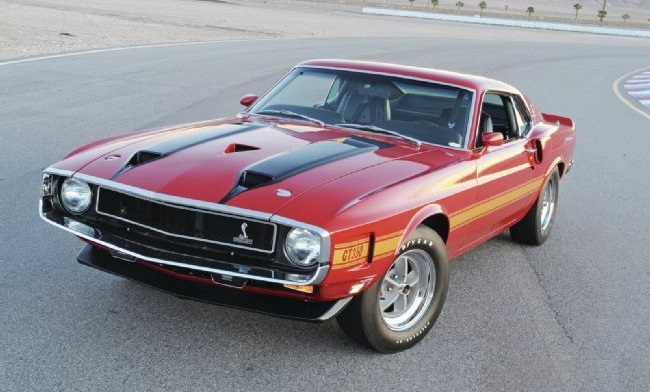
The 1970 Shelby Cobras were left over 1969 units retitled as 1970 models.
The only changes to the 1970 Shelby Cobras were the addition of two
black stripes on the hood, and a lower front chin spoiler.
|
